
When it comes to keeping your pet safe, the array of tracking options can feel overwhelming. GPS devices, microchips, Bluetooth trackers like Apple AirTags – each can potentially help reunite you with your pet if they go missing. But which technology actually delivers when every second counts?

As a leader in pet safety, Kippy understands that choosing the right tracking technology isn’t just about features—it’s about ensuring your family member comes home safely. Let’s examine the reality behind GPS vs microchips, Bluetooth tracker vs GPS tracker capabilities, and why an Apple AirTag is not a reliable tracking option for pet tracking.
Understanding the 3 technologies
GPS tracking provides real-time
location monitoring using satellite networks where you can stay connected with
your pet via an app on your smartphone. GPS is currently the most reliable pet
tracking technology on the market.
Microchip technology offers
passive identification for veterinary and shelter scanning whereby if your lost
pet is taken into a vet or animal shelter the chip can be scanned and your
contact details retrieved.
Bluetooth systems such as
AirTag use crowd-sourced network tracking with significant limitations. If your
pet is in a remote or rural location, the tracking feature may not work.
Each has its place in pet
safety, but only one provides comprehensive protection during emergencies.
The Microchip: Permanent identification, not live tracking
Let’s start with the most misunderstood technology. Microchips are identification devices, not tracking systems. These rice-sized implants that are usually applied under the skin between the pet’s shoulder blades by an animal professional contain no GPS technology, no battery, and no ability to transmit location data.
Microchips use passive RFID
technology activated only by special scanners. They contain a unique ID number
linked to your contact information, and require your pet to be found and
scanned by someone with proper equipment. Their effective scanning range is
just 5-10 centimetres from the scanner.
The main benefit of a microchip
is it’s a permanent identification that can’t be lost like a collar or tag with
universal scanning capability that can be completed at most veterinary clinics
and shelters. There’s no battery requirements for lifetime operation.
Microchips provide zero tracking capability, require someone to find your pet first and think to scan for a chip, depend entirely on scanner access, and offer no help during active search and rescue when time is critical.
Consider Sarah’s experience from Milan: “My dog Max got loose during a thunderstorm. His microchip was registered with my latest contact details, but that didn’t help me find him wandering scared through the city at night. The chip came into its own three days later when someone finally caught him and took him to a shelter.”

Bluetooth trackers: The AirTag
temptation
Apple AirTags seem
attractive—inexpensive, long battery life, widely available and
smartphone-integrated. However, AirTags are not promoted for keeping pets safe
– they are mainly for keeping track of household items such as luggage, keys
and wallets etc. A quick GPS vs AirTag comparison reveals serious safety
concerns for pet tracking.
AirTags use Bluetooth connection to nearby Apple devices, rely on the “Find My” network using other people’s phones to report location, have an effective range of 30-100 feet for direct connection, and depend entirely on Apple device density for network coverage.
The stark reality shows where a
dog Bluetooth tracker is in a remote location. AirTags will fail in remote
areas with no Apple devices nearby such as national parks and hiking trails,
rural communities with low smartphone adoption, agricultural areas and farms,
and emergency situations in sparsely populated regions. Even in cities,
coverage gaps exist where Apple device density drops below critical mass.
A farmer from Tuscany, Marco
Rossi, learned this firsthand: “Our border collie took off after sheep
that broke through a fence five kilometres into grazing land. The AirTag showed
her last known location from two hours earlier when she passed a road—then
nothing. We spent eight hours searching blind and fortunately she was found the
next day by a hiker.”
Additional AirTag limitations include physical vulnerability not designed for active pet wear.

GPS Tracking: The Gold Standard
for keeping your pet safe
GPS pet trackers use the same satellite technology that guides emergency responders and military operations. This isn’t crowd-sourced approximation—it’s precision location data available anywhere on Earth.
GPS works with direct connection
to 24+ satellites that provides global coverage, mobile data transmission
delivers real-time location updates with precision accuracy within 2-3 metres,
and comprehensive coverage works anywhere with satellite visibility.
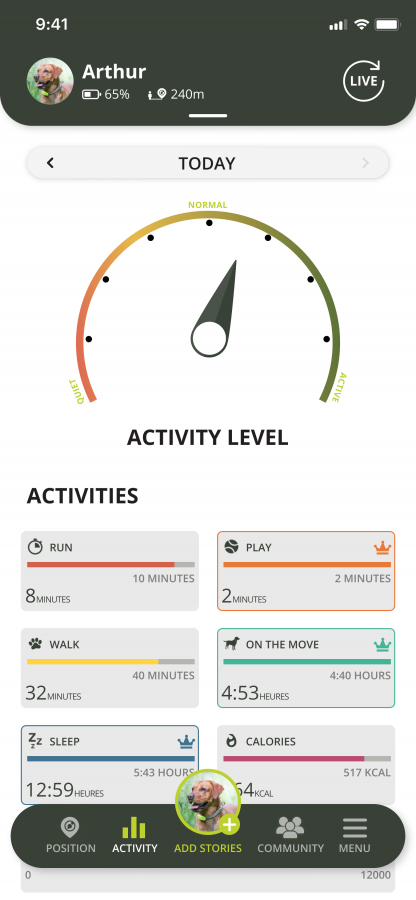
GPS gives users real-time tracking with live location updates, universal coverage in remote wilderness and rural communities, emergency-grade reliability with professional accuracy used by search and rescue teams, and in most cases such as Kippy weather-resistant design for extreme conditions.
NOTE: while satellite technology
gives worldwide coverage, the GPS device will work where the specific mobile
network is activated. Check with your GPS tracker provider.
Technology Comparison
| Feature | GPS (Kippy) | Microchip | Bluetooth (AirTag) |
| Real-Time Tracking | ✅ Live updates every 30 seconds | ❌ No tracking capability | ⚠️ Only when near Apple devices |
| Coverage | ✅ Works across EU | ❌ No tracking capability | ❌ Unreliable in rural areas |
| Emergency Response | ✅ Immediate location data | ❌ No assistance during search | ❌ Unreliable when needed most |
| Battery Life | ✅ 3-7 days active tracking | ✅ Lifetime (no battery) | ⚠️ 6-12 months |
| Water Resistance | ✅ to IP67 standard | ✅ Fully waterproof | ⚠️ Basic splash resistance |
| Setup Complexity | ✅ Simple app-based setup | ⚠️ Requires veterinary procedure | ✅ Easy smartphone pairing |
| Ongoing Costs | ⚠️ Subscription plan needed | ✅ No ongoing costs | ✅ No subscription needed |
Making the right choice
Urban pet parents benefit from a
microchip as critical backup for vet and shelter identification if your pet is
found and GPS tracking
for real-time location and other activity features. Bluetooth has limited
utility due to coverage gaps.
Rural pet parents have a microchip for identification if the pet is found by neighbours or hikers and taken to a vet, with GPS as the only real-time tracking option that works. Bluetooth cannot be relied on with little or no coverage. Active/outdoor families who hike, camp or hunt also need GPS tracking.
Senior dogs with cognitive
issues require GPS tracking as critical for disoriented pets who can’t find
their way home, especially during medical emergencies when real-time tracking
is essential for medication timing.
The complete safety strategy
Rather than choosing just one
technology, the most comprehensive approach combines multiple systems: GPS
tracking for active protection with real-time monitoring, microchip for backup
identification if the GPS device is lost or there’s no battery, and traditional
ID collar tags for immediate contact information.
Whilst microchips and Bluetooth trackers have roles in pet safety, only GPS tracking provides the immediate, actionable tracking information needed during the critical first minutes and hours when your pet goes missing.
Common misconceptions
“Microchips are enough for pet safety”
Microchips provide identification, not location data. They cannot help you find your lost pet unless the pet is taken to a vet or shelter to have their chip scanned.
“AirTags work everywhere smartphones do”
AirTags require dense populations of Apple devices to work. Rural areas and emergency situations often lack sufficient coverage.
“GPS tracking is too expensive”
When calculated per successful rescue, GPS tracking provides exceptional value. A single emergency veterinary visit often exceeds a year of GPS service.
“Bluetooth trackers are just as accurate as GPS”
Bluetooth accuracy depends on crowd-sourcing of devices and can give out of date data. GPS provides real-time precision location data.
The bottom line on keeping your pet safe
Your dog isn’t just a pet – they’re part of the family. Microchips serve an important role in identification but can’t help you find a lost dog. Bluetooth trackers might seem convenient but their coverage limitations can put pets at serious risk, especially in rural areas.
GPS tracking puts you in control, providing the real-time, reliable, global coverage that emergency situations demand. When every second counts, only GPS delivers the immediate, actionable information needed to bring your pet home safely.
The choice between GPS vs microchip dog tracking isn’t either/or—it’s about understanding each serves different purposes. The dog Bluetooth tracker vs GPS choice is clearer – one works when your pet needs help most, the other could fail when reliability matters. An AirTag can never match satellite precision when your family member’s life is on the line.
Choose the technology trusted by professionals, proven by results, and designed specifically for the pets you love.
Kippy: Your trusted partner in pet safety.