
Pet gps trackers available on online and offline shopping channels are increasingly numerous. Each of them allows certain activities to be performed and for this reason has specific features in its operation.
How do you choose a gps for your dog or cat that perfectly meets the needs of the owner and, of course, also the animal?
There are GPSs that work with a SIM card, others that use radio waves, some offer a simple localisation function, while others also have a range of services aimed at offering safety and well-being to the animal.
Before purchasing, it is therefore advisable to always pay close attention to the many aspects present in a tracker because these can make all the difference in the actual usefulness of the device.
In this article we will find out how to choose a gps for your dog or cat, focusing on what features to consider, battery life and ease of use of the device.
Gps for cats and dogs: features
The first thing to do when choosing a GPS for your dog or cat is to carefully evaluate the features it possesses: do they fully meet your needs in handling the animal and its needs?
In order to clarify one’s ideas in this regard, one must first consider a few important aspects, among them:
- whether the animal lives mainly indoors or is often outdoors;
- if it is a particularly lively dog or cat;
- whether he is often left alone during the day or whether there is almost always someone with him.
Only after you have understood what you really need can you start looking for the most suitable GPS.
A device that makes use of GPS technology is certainly safer and more accurate than one that uses simple Bluetooth, which is functional to be sure, but is mainly suitable for objects and not recommended when it comes to the safety of four-legged friends.
Pet GPS trackers therefore use Global Positioning System technology that is able to locate something or someone at the exact spot where they are, at all times.
Using specific satellites orbiting the Earth, the signals emitted by a tracker or GPS collar are picked up and then sent back to the exact position.
This is verifiable, in real time, directly from the pet owner’s smartphone, through a dedicated and easy-to-use app.
Other features of an excellent pet gps
When it comes to a pet tracker of this type, there may be some specific and very useful features for managing your four-legged friend.
It is therefore not only live tracking that can be activated, but also for example:
- the virtual fence. With this function, the pet owner can circumscribe one or more areas in which he wants his four-legged friend to remain. Within a safe zone, dogs and cats can therefore move around safely, as well as being spotted without difficulty. As soon as the animal crosses the marked boundaries, a notification immediately arrives on the owner’s smartphone so that he can take action to bring his pet back.
- the virtual leash. A useful service in a GPS tracker for dogs, especially if they are often left free to explore the territory, safely, without being tied to a leash. In this case, if the animal strays from the phone’s Bluetooth, an alert is triggered for the owner, who can then promptly retrieve it.
In addition to these functions, there are also other interesting ones, tailor-made for dogs and cats and useful for monitoring their health.
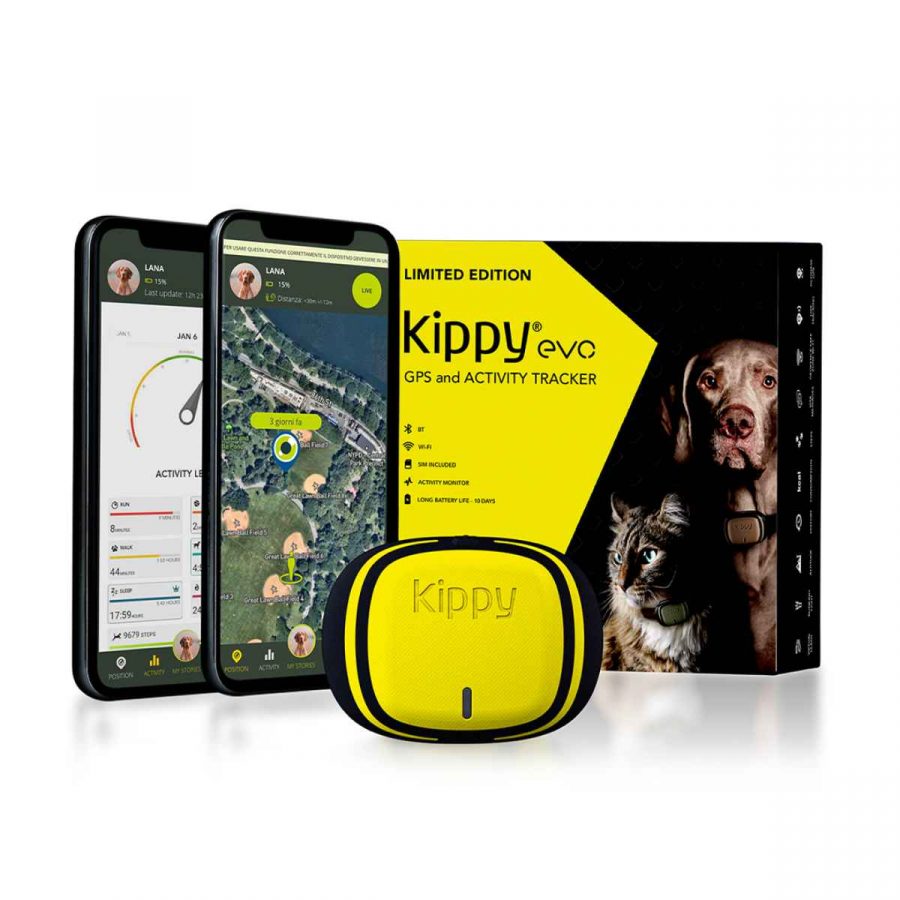
A device such as the Kippy EVO, one of the most advanced and reliable GPS-enabled devices on the market, not only reports the perfect position of the dog or cat, but also monitors the animal’s daily activities, from running to resting, from the number of steps to calories burned.
How long does your cat and dog gps battery last
Among the useful tips for understanding how to choose a gps for your dog or cat are the specifications regarding the battery life of the device.
A detail that is certainly not insignificant.
There are in fact precise factors that can determine the shorter or longer battery life such as:
- the functions used;
- the liveliness level of the animal;
- the average hours of use;
- 2G telephone coverage, for devices equipped with a SIM card such as Kippy;
- GPS satellite coverage;
- weather conditions;
- the Update Frequency time set via the App.
The same gps tracker for dogs and cats can therefore have a variable battery life depending on use due to the reasons just described.
Fortunately, there are trackers on the market today that guarantee a long life span. Kippy EVO, for example, has a rechargeable battery that can last up to 10 days and Kippy CAT, on the other hand, has an autonomy that ranges from 3-4 days, if the cat spends a lot of its time away from home, up to 12-13 days, if the feline is used to staying close to home.
In addition to the battery, however, there is another important factor to consider when choosing: the tracker’s ease of use. Let’s find out why.
Choose a dog and cat gps that is easy to use
Another feature that pet owners should not underestimate at all is the simplicity of using a dog and cat GPS.
The reason for choosing one that is easy to use is quite logical: in this way, you can be sure that you will be able to make proper use of all its features and thus make the most of its potential.
How to choose an easy-to-use gps for your dog or cat? What features should it have to be so?
It should, for one thing, be activatable in a few moves.
If the instructions are clearly provided, this can indeed be done in a short time.
Therefore, providing manuals or, even better, making a tutorial available to the user that illustrates the steps needed to get started is certainly a very good idea.
The ease of use of the device also relates to consulting the app dedicated to monitoring the animal’s activities.

Screens with clear and easy-to-read data, settings that are easy to manage, even for those not very familiar with technology, are all important factors that make life easy for pet owners who decide to attach a GPS tracker to their four-legged friend’s collar.
All these can sometimes even be features that can, in the long run, determine the very success of one device over another.
Finally, an easy-to-use GPS device must also have an easy attachment system to the animal’s harness or collar, with the possibility of release without any difficulty.
The Dog and Cat Gps is compatible with your smartphone
The popularity of gps trackers for animals is surely also due to the fact that everything, from the tracker settings to data retrieval, goes through a smartphone, i.e. an object that you practically always carry with you.
These are devices that require a subscription plan. This is why they are equipped with a SIM card that not only allows the activation of a series of useful functions for monitoring the safety and health of the dog, but also guarantees better coverage than GPS collars that instead use radio waves for their operation.
Kippy, for example, requires a data connection to be able to send the correct GPS position via the telephone network, guaranteeing unlimited monitoring of your pet throughout Europe.
Simply choose the service package you prefer, according to your needs, and immediately start using the tracker to its full potential.
Before buying one of these devices, however, it is always a good idea to check compatibility with one’s own phone so as not to run into problems and to enable a perfect connection between GPS tracker and smartphone.
In fact, all apps usually need certain technical requirements related to the operating system in order to function properly.
When first using the tracker, only a few very simple steps are required to connect it to the phone. If well designed, everything is done easily and in a short time, so that all services can be activated quickly.
Now that you understand how to choose a gps for your dog or cat, you just have to decide which one is right for you and your four-legged friend.
FAQs – Answered by Kippy
How do I know which GPS tracker is best for my pet?
To choose the right GPS tracker, think about your pet’s lifestyle. If your dog or cat spends a lot of time outdoors, is very active, or tends to wander, you’ll want a tracker with real-time GPS, wide range, and long battery life. For indoor pets or those that stay nearby, a simpler device may be enough. It’s important to match the features of the tracker with your actual needs.
Is a GPS tracker better than Bluetooth or radio-wave devices?
Yes, in most cases. GPS trackers that use SIM cards and mobile networks offer real-time location tracking, which is much more accurate and reliable than Bluetooth or radio-wave alternatives. Bluetooth trackers only work within short range, while GPS devices allow you to find your pet even if they are far away — as long as there is mobile coverage.
Do I need a subscription to use a GPS tracker like Kippy EVO or Kippy CAT?
Yes. Devices like Kippy EVO and Kippy CAT use SIM cards and need a data connection to send GPS location updates. This requires a subscription plan, which you choose when setting up the tracker. The subscription ensures unlimited tracking across covered regions, such as all of Europe.
How long does the battery last on a pet GPS tracker?
Battery life varies depending on how active your pet is, how often you use live tracking, and the quality of mobile and satellite signal in your area. For example, Kippy EVO can last up to 10 days, while Kippy CAT can last 3 to 13 days depending on how far and how often your cat roams. Using more frequent updates will reduce battery life.
What is a virtual fence, and how does it work?
A virtual fence is a feature that lets you set a safe zone for your pet. If your dog or cat leaves this zone, the tracker sends a notification to your smartphone right away. This helps you act quickly if your pet goes too far or wanders into an unsafe area.
What is a virtual leash, and when would I use it?
A virtual leash is helpful when your pet is exploring freely but should stay near you. It uses Bluetooth to monitor the distance between your phone and the tracker. If your pet strays beyond that distance, you receive an alert. This is especially useful during walks without a physical leash.
Can the GPS tracker help monitor my pet’s health?
Yes. Advanced trackers like Kippy EVO go beyond location tracking by monitoring your pet’s daily activity, including movement, rest time, calories burned, and more. These insights can help you understand your pet’s overall well-being and adjust their routine if needed.
Is it easy to set up and use a GPS tracker?
Most modern GPS trackers are designed to be simple to set up. Once you attach the tracker to your pet’s collar, you usually just need to install the companion app, follow a few steps to pair the device, and choose your settings. Look for trackers with clear instructions or setup tutorials to make the process even smoother.
Does the tracker work with any smartphone?
Before buying, check that the tracker app is compatible with your phone’s operating system. Most apps support recent versions of iOS and Android. If your phone is outdated, you may need to update the system or use a different device to access the tracker’s features.
How does the app help me track my pet?
The companion app is where you’ll see your pet’s real-time location, get alerts if they leave a safe zone, and check activity stats. A good app should be easy to navigate, show clear maps and data, and let you adjust settings like location update frequency. The better the app experience, the more useful the GPS tracker will be in daily life.
Who to call if you find a lost dog?
If you come across a dog that is probably lost or wandering stray in the street, you should promptly report the fact to the Municipal Police of the municipality where it has been spotted so that the Public Catch Service can be activated. In this way the animal can be rescued by specialised persons and then taken to a first-aid kennel.
Why do cats leave home?
In the case of a female specimen, estrangement is common when she is pregnant. As she does not consider the place she is in to be quiet enough, she prefers to go in search of a secluded and safe refuge where she can give birth to her cubs.
Why does the dog run away?
Like us humans, dogs get bored. Their nature is that of explorers and they certainly suffer if they are forced to live a sedentary and perhaps monotonous life. It is usually their instinct to get away, to have a new adventure and then return home.