
All dog and cat owners are anxious to keep their four-legged friends safe. After all, each pet is unique in its personality – some are very lazy and always clinging to their human companions, while others, especially in their first years of life, are very hyperactive and curious, always excited by the idea of going around to see things, people and new places. But sometimes they want a little more freedom, or because of a little inattention, they stray too far and get lost. Nowadays, fortunately, technology is helping us to keep track of our pets’ movements so that we always know where they are and maybe even get some more information, as in the case of Kippy.
There are many different types of trackers, especially non-GPS ones. The most famous bluetooth one is undoubtedly Apple’s AirTag, which has improved an already-existing technology, though it still offers very limited functionality due to its small size. The approach behind the two technologies is very different. Kippy allows for borderless tracking, worldwide, while AirTag has a very limited range, despite having some tricks up its sleeve.

All dog and cat owners are anxious to keep their four-legged friends safe. After all, each pet is unique in its personality – some are very lazy and always clinging to their human companions, while others, especially in their first years of life, are very hyperactive and curious, always excited by the idea of going around to see things, people and new places. But sometimes they want a little more freedom, or because of a little inattention, they stray too far and get lost. Nowadays, fortunately, technology is helping us to keep track of our pets’ movements so that we always know where they are and maybe even get some more information, as in the case of Kippy.
There are many different types of trackers, especially non-GPS ones. The most famous bluetooth one is undoubtedly Apple’s AirTag, which has improved an already-existing technology, though it still offers very limited functionality due to its small size. The approach behind the two technologies is very different. Kippy allows for borderless tracking, worldwide, while AirTag has a very limited range, despite having some tricks up its sleeve.
GPS and Bluetooth localisation
The ‘secret’ behind this difference in effectiveness is that the AirTag is not a GPS tracker, but is essentially based on a Bluetooth connection with a range of about ten metres indoors and thirty outdoors – practically within eyeshot and therefore mostly useful with small objects. Kippy, however, is based on a more articulated and complex system – a real GPS tracker that constantly sends data on its position to a server via a GSM connection which can be accessed from anywhere in the world. If our dog is at home, in Italy, with relatives, and we are travelling on the other side of the world, we will still be able to use Kippy to locate our friend.
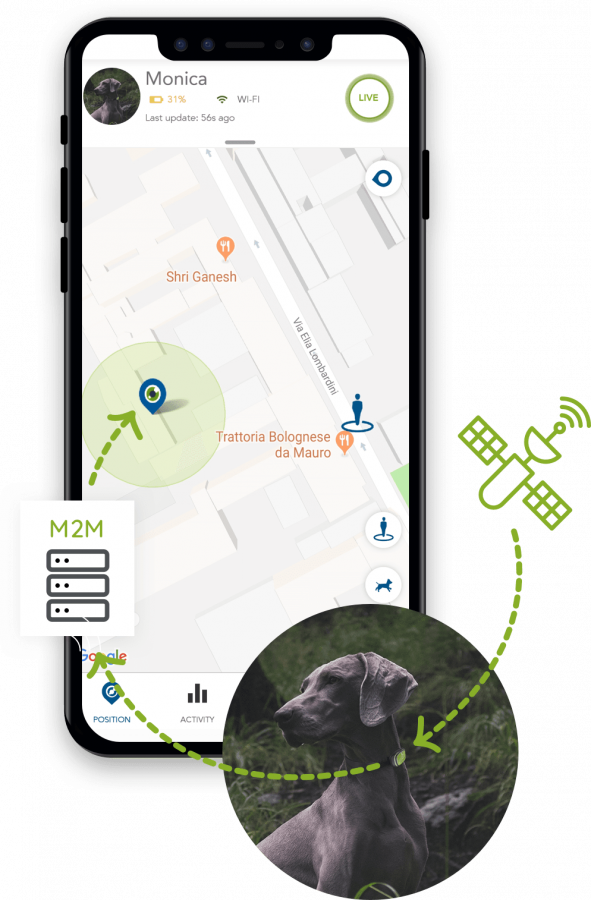
It should be pointed out that AirTag can extend its range of action by exploiting the connections of other iPhones, but this is a solution that is as clever as it is inefficient. To locate AirTag outside the range of our phone, a person with a latest-generation iPhone and an active connection must be passing in the vicinity. A combination requiring a certain amount of luck to achieve; with Kippy, however, this is not necessary since it is equipped with its own 2G GSM connection, the same as the mobile phones we used to use a few years ago. By hooking up to the networks of the telephone operators with the greatest coverage, Kippy is able to stay in touch with your phone anywhere in the world all on its own.
Beyond localisation: activity tracking
Unfortunately, this is the end of the comparison, because the AirTag’s functions are limited to locating nearby objects in a simple and limited manner. It was created essentially so that you wouldn’t forget your keys and other objects, but it is of little use as a localisation system for animals that are able to move around independently and can be miles away. Kippy was conceived with the needs of pet owners in mind, which is why it can provide information that goes far beyond the location, albeit unlimited.
Kippy is also useful for keeping track of your dog or cat’s daily activities and monitoring its health. It’s a bit like the canine or feline equivalent of the smartwatches we wear. An algorithm processes the information that Kippy manages to detect, and in this way it is able to ‘understand’ when our pet is running, playing, sleeping, etc., and even calculate steps and calories burned. A complete monitoring of our four-legged friend’s activity that gives us a complete picture of their daily life and a very useful tool for keeping their health under control.
FAQs – Answered by Kippy
What’s the difference between a GPS tracker and a Bluetooth tracker for pets?
A GPS tracker like Kippy provides real-time location updates anywhere in the world using satellite and mobile data. A Bluetooth tracker (like AirTag) only works within short distances—typically under 30 meters—and relies on nearby smartphones.
Can I use an Apple AirTag to track my dog or cat?
You can, but it has serious limitations. AirTags rely on nearby Apple devices for location updates and don’t provide live tracking. They aren’t designed for animals and may not be reliable if your pet goes missing.
Does Kippy work if I’m far away from my pet?
Yes. Kippy uses GPS and GSM cellular networks, so you can track your pet in real time from anywhere in the world—even if you’re in another country.
Do Bluetooth trackers work without the internet?
Yes, but only within a very short range and with your phone nearby. They don’t have their own data connection and can’t provide updates once out of range.
How accurate is GPS tracking with Kippy?
Very accurate. Kippy combines GPS, GSM, and Wi-Fi triangulation to give precise real-time location, even indoors or in remote areas.
Can Kippy do more than just show my pet’s location?
Yes. Kippy also tracks your pet’s daily activity—steps, sleep, playtime, calories burned—just like a smartwatch does for people.
Do I need a subscription to use Kippy?
Yes. The subscription includes mobile data, real-time location updates, and access to advanced features like activity monitoring and geofencing.
Is GPS tracking safe for pets?
Absolutely. Devices like Kippy are lightweight, non-invasive, and designed to be safely worn on your pet’s collar.